Bring CPR training to your community so more people can save lives
Free, open-source CPR kiosk software. Paired with a manikin and a sensor, it guides every compression in real time, so people learn to save a life without an instructor.
Source: AHA, CPR Facts and Stats.
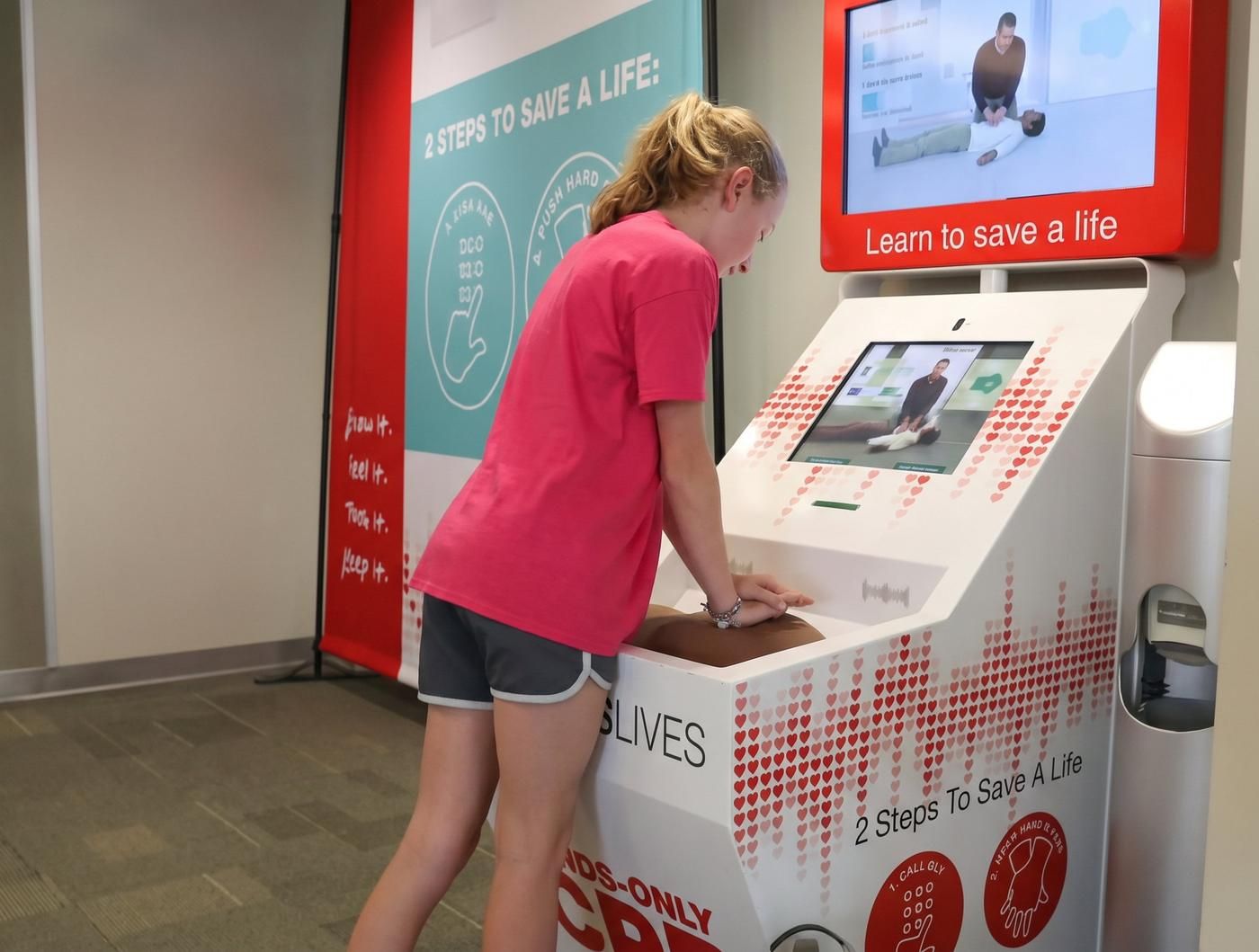
Free code that turns a CPR manikin into a self-service training kiosk
A sensor inside the manikin reads every compression. The screen guides people to push 100 to 120 times per minute, following the beat of a metronome.
Anyone can walk up and practice in a few minutes. Below, you'll find everything you need to set one up in your community and start making a difference.
The code is free. You bring the hardware
Your organization sources the manikin, sensor, Arduino and a laptop or PC. Most of it is off the shelf.
Need funding for the hardware? See grants that cover CPR equipment in our FAQ.
What we send you
- i.CPR kiosk appThe app visitors use: instructions, metronome-paced practice and live feedback.
- ii.Scoring serviceThe backend that processes each session and emails results.
- iii.Sensor firmwareArduino code that reads the sensor inside the manikin in real time.
- iv.Build guideThe parts list to buy, sensor placement and kiosk setup steps for your site.
- v.Direct supportQuestions during your first deployment go to the team that built it.
A CPR feedback device anyone can build
A sensor, an Arduino and a laptop or PC turn a standard CPR manikin into a kiosk that reads every compression and gives real-time CPR feedback. It plays like a game, so people come back.
A sensor in the manikin
A distance sensor fits inside a standard adult CPR manikin. The build guide shows where it goes.
Firmware on an Arduino
The firmware reads each compression in real time and sends it on.
A scoring service
A small server turns raw readings into rhythm and performance data.
The kiosk app
A metronome sets the pace at 100 to 120 compressions per minute while feedback reacts to every push.
Results by email
Each visitor gets their score by email when the session ends.
For everyone building a heart-safe community
If people pass through your space, a kiosk can teach them CPR while they wait, walk by or take a break.

Cities and municipalities
City halls, transit stations and parks. Fits HeartSafe Community programs.

Schools and universities
Give students a way to practice and repeat on their own, alongside your CPR graduation requirement.

Nonprofits and foundations
Run community CPR training without paying an instructor at every event.

Hospitals and health systems
Lobbies, waiting rooms and community-benefit programs.

Libraries and community centers
Places people already visit to learn something new.

Workplaces and venues
Add hands-on CPR practice to your workplace safety and AED program.
Why we're giving it away
Light-it is a healthcare software development company. We design and build digital health products for healthcare organizations.
A tool that teaches people to save lives should be free. So we're giving the OpenCPR code to any organization that wants it: schools, cities, nonprofits, hospitals, libraries and workplaces.
Visit lightit.ioEverything you need to get started
What is a hands-only CPR kiosk?
A self-service station where anyone can practice hands-only CPR on a manikin and get real-time feedback on their compressions. No instructor is needed. OpenCPR gives you the software to build one.
Is OpenCPR open source?
Yes. The OpenCPR code is open source and free to use, adapt and deploy. Request it through the form and we'll send the code, the build guide and a direct line to our team for your first deployment.
How much does a CPR kiosk cost?
The OpenCPR code is free. Hardware is not included: your organization provides a CPR manikin, a distance sensor, an Arduino board and a laptop or PC. Many organizations already own a manikin, which brings the budget down further.
Are there grants for CPR training equipment?
Yes. A few places to start in the US:
- Firehouse Subs Public Safety Foundation: lifesaving equipment grants for public safety organizations. Past awards have covered CPR manikins and AED trainers.
- Walmart Spark Good Local Grants: $250 to $5,000 for nonprofits, schools and local governments in a store's service area.
- School CPR and AED funding: public school districts can look at federal grants for student CPR and AED programs and at state programs, like the CPR and AED grant in Kansas.
- Local funders: community foundations, Rotary and Lions clubs, and hospital community-benefit programs often support community health projects.
Since the code is free, your grant only needs to cover the hardware.
What is the correct CPR compression rate and depth?
For adults, push hard and fast in the center of the chest at 100 to 120 compressions per minute and about 2 to 2.4 inches deep, letting the chest fully recoil between compressions. The kiosk coaches visitors to that rhythm.
Can schools use it for CPR graduation requirements?
Most US states require CPR training to graduate from high school. The kiosk gives students hands-on practice between classes. It supports the instruction your state requires but does not replace it.
Does the kiosk replace CPR certification?
No. The kiosk teaches hands-only CPR and builds muscle memory. It is a training tool, not a certification course or a medical device. People who want certification should take an accredited course.
Which manikins and parts work with it?
We don't supply hardware. The software is designed around a standard adult CPR manikin with a distance sensor placed inside, which you source. The build guide lists the parts to buy and shows sensor placement step by step.
Do we need developers to set it up?
Not necessarily. Someone comfortable following technical instructions can set it up with the build guide. If you don't have that person, our team helps with your first deployment.
Why is there a form to get the code?
The code is open source. The form lets us send you the right package, help with your first deployment, and count how many communities OpenCPR reaches. We review requests and reply by email.
Can we use it outside the United States?
Yes. OpenCPR is available to organizations anywhere. Tell us your country in the form and we'll let you know what's ready for your region.
Get the code and the build guide
Tell us about your organization and we'll email you everything you need to set up your first kiosk.
- Free and open source. No contract, no fees, no sales calls.
- Everything by email. The code, the build guide and the parts list.
- Support from the team that built it. Direct help with your first deployment.
Thank you. Talk soon
We'll email you the code and build guide.
- We'll review it. Our team reads every request personally and replies within 2 business days.
- You get the package by email. The code, the build guide and the parts list.
- While you wait, see grants that can cover the hardware.
Questions? Write to hello@opencpr.org.
More kiosks mean more people ready to save a life